
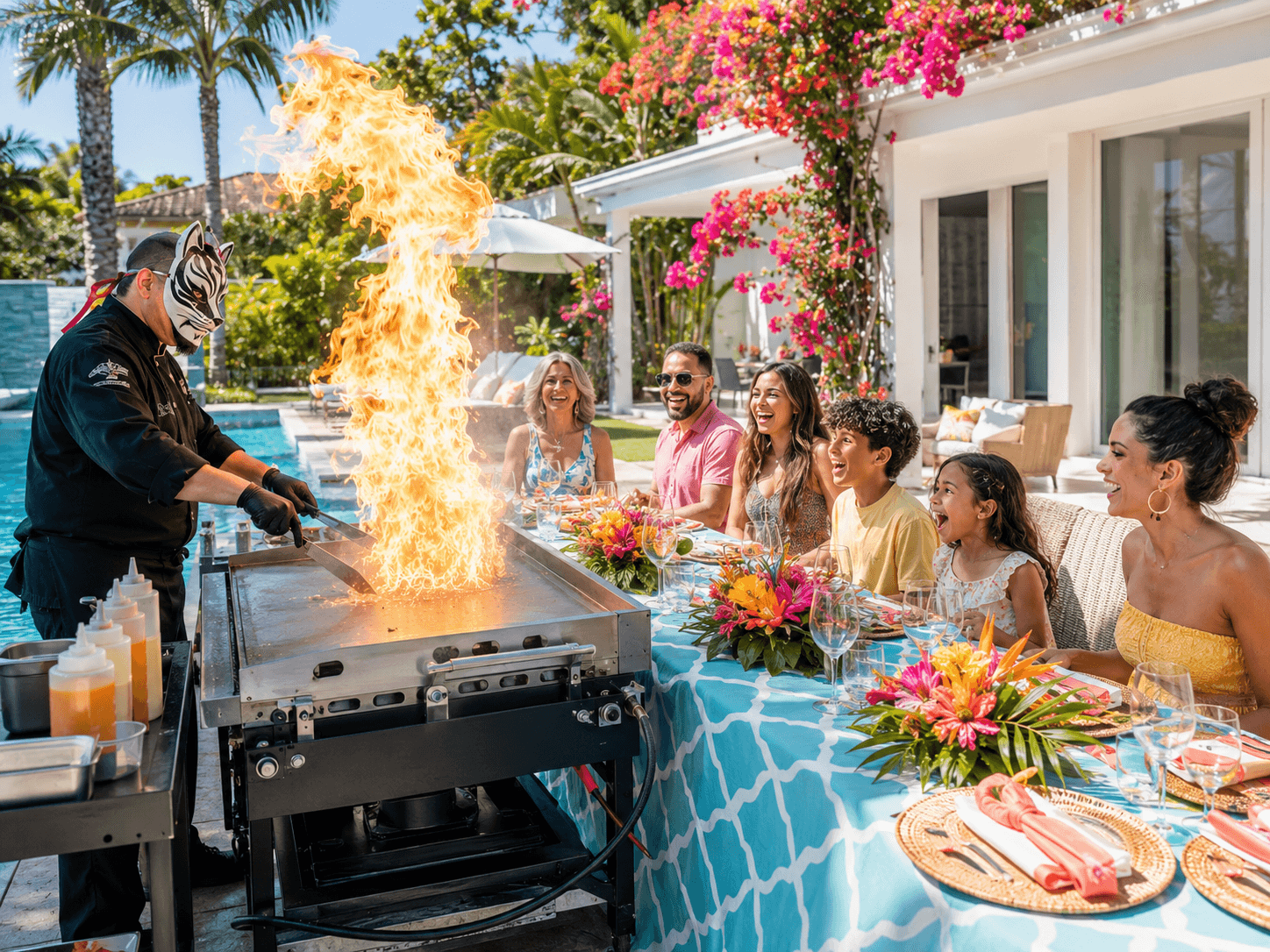
A hibachi dinner party at home is one of those events that sounds complicated but is actually one of the easiest parties to throw. Here's why: the chef handles everything. They show up with the grill, the food, and the entertainment. Your job is to set up seating and show up.
That said, a few thoughtful decisions on your end make the difference between a good event and one guests talk about for years. Here's how to host a hibachi dinner party that lands.
What Makes a Hibachi Dinner Party Different
At a standard dinner party, you're in the kitchen while guests sit around waiting. At a hibachi party, the cooking IS the party. Your chef cooks live in front of everyone — performing knife tricks, onion volcanoes, and fire shows while preparing each guest's plate to order. Guests are entertained, engaged, and eating fresh food all at the same time.
It removes all the hosting stress of a dinner party (what if the food isn't good? what if I burn something?) and replaces it with a professional experience your guests genuinely didn't expect.
Step 1: Pick the Right Size
Hibachi dinner parties work best for groups of 10–30 people for a single intimate event. Smaller than 10 and the per-person cost gets high relative to the minimum. Larger than 30 and you may want two chefs cooking simultaneously so everyone eats at the same time.
For a classic dinner party vibe — close friends, a real sit-down experience — aim for 12–20 guests. That size keeps the experience intimate and ensures everyone is close enough to watch the show clearly.
Step 2: Set Up Seating That Faces the Grill
The single most important layout decision: everyone should face the chef. Think of the grill as a stage. Arrange tables in a U-shape or semi-circle around it, or set up long banquet tables on two or three sides.
Avoid seating anyone with their back to the chef — they'll miss the show and feel disconnected from the experience. If you're in a tight backyard, a single long table on one side of the grill works fine.
What you need to provide:
- Tables and chairs (folding tables work perfectly)
- Plates, utensils, and napkins
- Glasses and drinks — the catering covers food only
Step 3: Set the Atmosphere
The chef provides the main entertainment, but a few simple touches from you complete the experience:
- Lighting: String lights or lanterns transform a backyard dramatically. For an evening event, warm string lighting overhead makes the whole space feel intentional. It also makes the fire show look incredible.
- Music: Soft background music (lo-fi, jazz, or light Japanese-inspired playlists) sets the mood before the chef starts. Once the show begins, the chef's performance becomes the soundtrack.
- Table setting: Simple tablecloths and a few candles. You don't need elaborate centerpieces — the grill is the centerpiece.
- Drinks station: Set up a self-serve drink area (cooler with drinks, ice bucket, cups) so guests help themselves without needing you to run back and forth.
Step 4: Think About the Flow
Hibachi dinner parties work best when guests arrive and mingle for 20–30 minutes before the chef starts cooking. This gives time for:
- Everyone to arrive (latecomers don't miss the cooking)
- Guests to get a drink and settle in
- The chef to finish setup
Once the chef starts, the event has a natural flow: fire show → cooking proteins → serving everyone → dessert or continued socializing after. The whole cooking and service window usually runs 60–90 minutes for a standard group.
Step 5: Coordinate Dietary Restrictions in Advance
When you book, share any allergies or dietary restrictions with us. Common accommodations:
- Vegetarian: tofu is a full protein option, cooked on a separate section of the grill
- Shellfish allergy: easy to skip shrimp/scallops/lobster and cook that guest's proteins first on a clean surface
- Gluten sensitivity: tamari instead of soy sauce, skip gyoza
You don't need to collect individual orders from every guest ahead of time — most hibachi chefs take orders tableside as they cook. But flagging serious allergies in advance ensures the chef is prepared.
What the Chef Handles (Everything Important)
To be clear about what you don't have to do:
- The chef brings the grill, propane, and all cooking equipment
- The chef brings all fresh ingredients and sauces
- The chef sets up 15–20 minutes before your guests eat
- The chef takes protein orders from each guest individually
- The chef performs the fire show and entertainment
- The chef cleans up the cooking area after service
You handle: seating, plates, drinks, and the social hosting. That's it.
Hibachi Dinner Party Ideas by Occasion
- Birthday dinner party: have the chef do the onion volcano candle trick at the birthday person's plate — it's a showstopper moment
- Anniversary dinner: intimate hibachi for two couples or a small group of 6–8 feels genuinely luxurious
- Friend group reunion: perfect for groups that don't see each other often — the entertainment gives everyone something to bond over immediately
- Holiday dinner party: a hibachi dinner party replaces the stress of cooking an elaborate holiday meal with zero effort on your end
- Date night at home: a private hibachi chef for a dinner party of two is genuinely one of the most memorable date night ideas available
How Much Does a Hibachi Dinner Party Cost?
At HibachiLover: $55/adult, $30/child, $550 minimum. For a dinner party of 15 adults, you're looking at roughly $825 food + travel fee + tip — typically $1,050–$1,250 all-in.
That's comparable to a high-end restaurant for 15 people, with the added benefit of a private chef, full entertainment, and the ability to stay in your own home as long as you want after the meal.
Get an instant estimate for your dinner party, or book your date online. We serve 27 states with professional hibachi chefs available 7 days a week.